
How We Plan a National Park Day With Three Kids
By Jessie Salmonson · Originally published on Field to Ridge
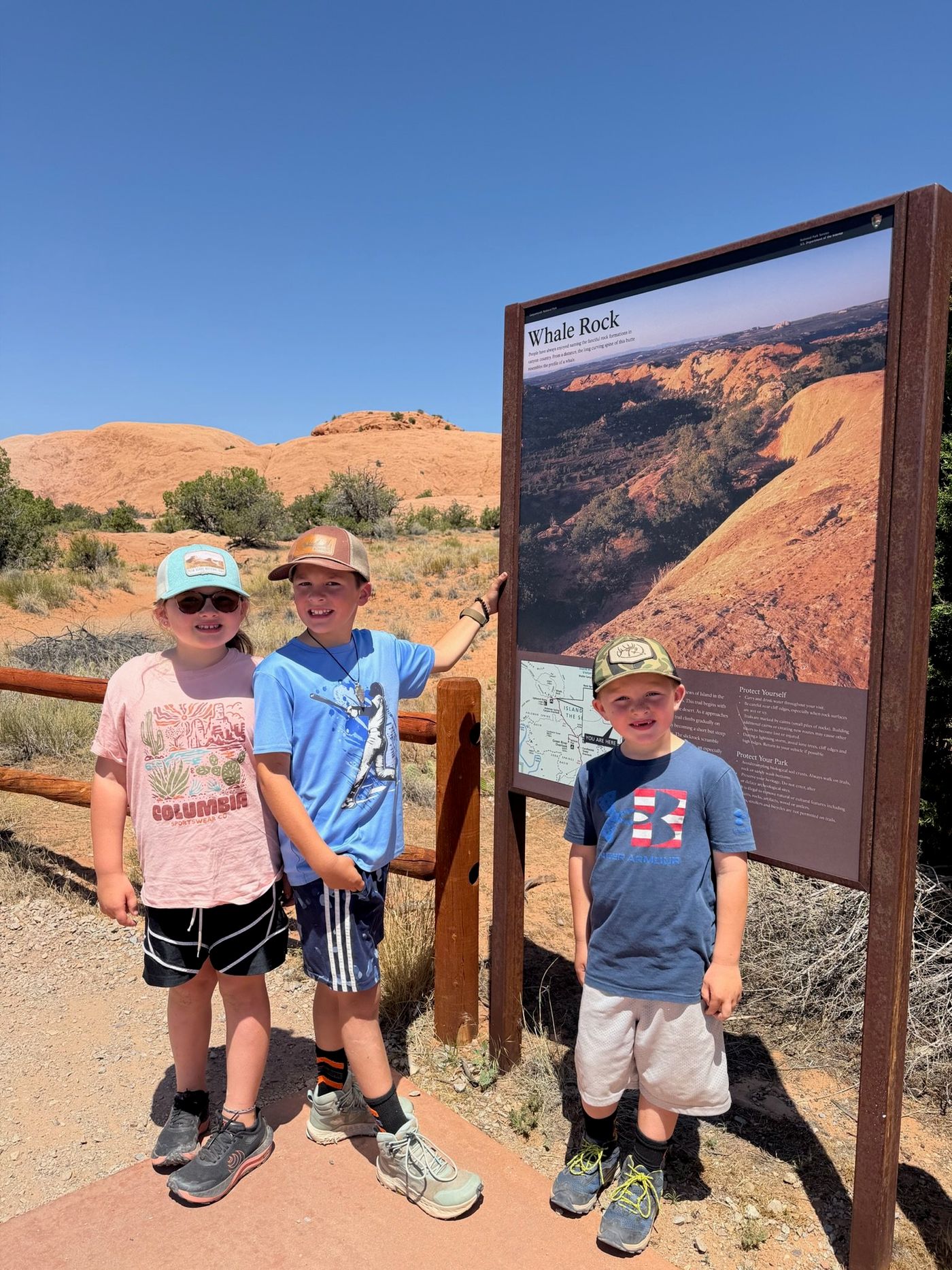
Our realistic approach to seeing a lot without making everyone miserable
Before we started traveling full-time, I could make a beautiful itinerary.
Wake up.
Visitor center at 8:00.
Hike at 9:00.
Lunch at noon.
Scenic drive.
Two overlooks.
Another short hike.
Dinner.
Sunset.
Perfect.
Then you add three kids.
Someone can’t find their shoes.
Someone doesn’t want the breakfast you made.
Someone needs to use the bathroom five minutes after leaving the campground.
The parking lot you planned to use is full.
The trail takes an hour longer than expected.
And by 3:00 p.m., everyone is tired and the beautiful itinerary you spent hours making doesn’t matter anymore.
After four months of visiting national parks with our three kids, I’ve learned that planning still matters—a lot.
But the way I plan has changed.
I don’t try to create the perfect schedule anymore.
Instead, I try to build a day that gives us direction while leaving enough flexibility for real life.
Because our goal isn’t to check off everything in a national park.
It’s to actually enjoy being there.
I Research Before We Arrive
I still do a lot of planning.
Probably more than most people.
Before we arrive at a national park, I want to understand the layout.
Where are we camping?
How far are we from the main areas?
Which roads connect everything?
Where are the visitor centers?
Which hikes are priorities?
What requires reservations?
Where does parking become difficult?
What time should we arrive?
Are there places to eat?
Where can we refill water?
And most importantly:
What do we really want to do?
That last question helps me narrow everything down.
National parks can be overwhelming.
You search for things to do and suddenly have a list of 25 hikes, 14 overlooks, three scenic drives, two visitor centers, and six places someone online says you absolutely cannot miss.
We’re not doing all of that.
So before we ever start the day, I separate the things that would be nice to see from the things we’d actually be disappointed to miss.
We Pick One Main Adventure
This might be the biggest change I’ve made.
Instead of building the day around ten different stops, I usually want one main adventure.
Most of the time, that’s a hike.
At Grand Teton, it was Jenny Lake, Hidden Falls, and Inspiration Point.
At Rocky Mountain, it was Bear Lake to Nymph, Dream, and Emerald Lakes.
At Bryce, it was getting below the rim and hiking among the hoodoos.
That becomes the anchor for the day.
Everything else is extra.
If the kids are doing great afterward, we keep exploring.
If everyone is tired?
We go back to camp.
This has taken a lot of pressure off our days.
We don’t finish a big hike and immediately feel like we’re behind schedule because we’re supposed to be somewhere else in 20 minutes.
We did the thing we came to do.
Everything after that is a bonus.
We Start Early
Unfortunately, this one keeps proving itself.
The earlier we start, the better our national park days tend to go.
We’ve had 4:00 a.m. alarms on this trip.
I don’t think every national park day needs to start at 4:00 a.m.
But there are times when it is absolutely worth it.
Jessie and Hudson started down the South Kaibab Trail at 4:45 a.m. so they could hike to Skeleton Point and get back before the Grand Canyon heat became a problem.
In Yellowstone, we woke up around 4:00 a.m. so we could reach Lamar Valley when wildlife was active.
Other times, starting early is simply about parking.
Jenny Lake taught us that.
We arrived around 8:45 a.m., and the parking lot was already full. We ended up parking farther down the road and walking in.
National parks are busy.
Especially during summer.
An early start usually means cooler temperatures, fewer crowds, easier parking, and more time to adjust when something doesn’t go according to plan.
The hardest part?
Getting three kids moving.
We Prepare the Night Before
Early mornings are considerably easier when we aren’t trying to find everything in the dark.
So we try to get as much ready as possible the night before.
Hiking bags.
Water.
Snacks.
Jackets.
Shoes.
Junior Ranger books if we need them.
Fishing gear if we’re bringing it.
Anything we know we’ll need goes together.
The goal is to remove as many morning decisions as possible.
Because waking children up early is hard enough.
I don’t also want to be asking:
“WHERE IS YOUR OTHER SHOE?”
at 5:30 in the morning.
Although somehow this still happens.
Food Can Make or Break the Day
We bring food.
A lot of food.
We usually eat breakfast before leaving or bring something with us if we’re starting extremely early.
Then we pack lunch.
And snacks.
And more snacks.
I’ve learned that hungry kids can go from perfectly happy to completely finished with hiking remarkably quickly.
Sometimes the solution isn’t turning around.
It’s sitting beside a lake for fifteen minutes and eating something.
We’ve had some of our favorite lunches sitting on rocks beside lakes or at picnic areas between adventures.
It’s cheaper than constantly buying food inside national parks, but more importantly, it keeps our day flexible.
We don’t have to plan everything around finding a restaurant at noon.
When everyone gets hungry?
We eat.
Junior Ranger Programs Are Part of Our Plan
Our kids have completed Junior Ranger programs throughout this trip, and they’ve become one of our favorite parts of visiting national parks.
But we’ve learned not to save the entire booklet for the end of the day.
If we stop at the visitor center in the morning, we get the books.
Then the kids can work on them throughout the day.
They might need to identify wildlife.
Look for something on a trail.
Learn about geology.
Answer questions about a place we’re already visiting.
That makes the program part of the experience instead of homework we’re desperately trying to finish before the visitor center closes.
And when they finally get sworn in and receive the badge?
They’re proud of it.
Our collection of Junior Ranger badges is becoming a pretty cool record of where we’ve been.
We Group Things by Location
This is one of the simplest things you can do when planning a national park day.
Stop driving back and forth across the park.
Some parks are enormous.
Yellowstone taught us this better than anywhere.
You can easily spend hours driving if you don’t understand how everything is laid out.
So I try to group activities together.
If we’re exploring one section of the park, we’ll look for hikes, overlooks, picnic areas, visitor centers, and other stops nearby.
Then we move on to another area another day.
This isn’t always possible.
But every hour we don’t spend driving is another hour the kids can actually be doing something.
And after Yellowstone, we’ve learned that our family definitely prefers doing over driving.
We Leave Room for the Plan to Fail
Jenny Lake might be my favorite example of this.
We had a plan.
Arrive at Jenny Lake.
Explore the visitor center.
Take the boat shuttle.
Hike to Hidden Falls and Inspiration Point.
Simple.
Except when we reached the boat launch, the wait was more than an hour and a half.
We had two options.
Stand there and wait.
Or change the plan.
We told the kids we were walking around the lake instead.
They were thrilled.
Okay.
They absolutely were not thrilled.
There were sighs.
There were eye rolls.
Then there was some discussion involving ice cream.
And off we went.
We hiked around Jenny Lake, past Moose Ponds, saw a moose, reached Hidden Falls, climbed to Inspiration Point, and had an incredible day.
If I had been too attached to the original itinerary, that day could have become frustrating.
Instead, it became one of our favorite memories from Grand Teton.
A plan is helpful.
Being willing to abandon it is sometimes even more helpful.
We Watch the Kids, Not the Clock
This has taken practice.
An itinerary says we’re supposed to leave at 1:00.
But maybe the kids are happily throwing rocks into a lake.
Or fishing.
Or watching an animal.
Or asking a ranger questions.
Why are we rushing them away?
On the other hand, maybe it’s only noon and everyone is clearly done.
Why force another three stops just because they’re written down?
We’ve become much better at reading the family.
Are the kids still having fun?
Are they tired?
Hungry?
Hot?
Are Jessie and I tired?
Is everyone getting irritated?
Would another activity actually improve the day?
Sometimes the answer is yes.
Sometimes the best thing we can do is go back to the campground.
We Don’t Underestimate Campground Time Anymore
Before this trip, campground time probably wouldn’t have appeared on my national park itinerary.
Now I intentionally leave room for it.
Our kids love riding bikes.
Playing football.
Exploring.
Fishing.
Building campfires.
Sometimes they’ll spend hours doing something at the campground that costs nothing and wasn’t listed anywhere under “Top Things to Do.”
And they’re happy.
That’s part of the trip too.
We don’t need to keep them entertained every second simply because we’re inside a national park.
Sometimes the best ending to a national park day is coming back to camp, making dinner, and letting everyone play until dark.
We Always Have a Plan B
Weather changes.
Trails close.
Parking fills.
Kids wake up tired.
Smoke rolls in.
Someone doesn’t feel good.
Sometimes the adventure you planned simply isn’t going to happen.
So I usually have a couple of backup ideas.
Maybe instead of the long hike, we do two short ones.
Maybe we drive the scenic road.
Maybe we go fishing.
Maybe we visit the visitor center and work on Junior Ranger books.
Maybe we spend the afternoon at a lake.
Having alternatives keeps one problem from ruining the entire day.
We Know When to Call It
This is probably one of the hardest things for me.
I planned it.
We’re here.
I want to see it.
We’re probably never going to be in this exact place again.
Let’s just do one more thing.
Sometimes that’s fine.
Sometimes that’s exactly how you turn a great day into a miserable one.
We’ve learned that there’s value in ending while everyone is still having fun.
We don’t have to squeeze every possible experience out of every day.
There will always be another trail.
Another overlook.
Another thing we didn’t see.
That’s okay.
Our kids aren’t going to remember whether we completed my itinerary.
They’re going to remember how the day felt.
What Our National Park Days Actually Look Like
So after four months, our ideal day usually looks something like this:
Start early.
Do our biggest adventure first.
Eat lunch somewhere beautiful.
Visit a few nearby stops afterward if everyone still feels good.
Work on Junior Ranger books along the way.
Then head back to camp.
The kids play.
Jessie and the boys might fish.
We make dinner.
Maybe build a campfire.
And if there’s something worth seeing at sunset, sometimes we head back out.
It’s simple.
And that’s the point.
We don’t need ten activities to have a great day.
You Don’t Need the Perfect Itinerary
I love planning.
That hasn’t changed.
If anything, traveling this much has made me appreciate a good plan even more.
But I’ve learned that the purpose of planning isn’t to control the day.
It’s to understand our options.
A good plan tells me where we should start.
What matters most.
What requires an early arrival.
What’s nearby.
What we can skip.
And what we can do instead when everything changes.
Then we go.
Some days follow the plan almost perfectly.
Others don’t resemble it at all.
And sometimes those are the best ones.
After four months of national parks with three kids, I don’t think the secret is creating the perfect family itinerary.
I think it’s knowing what matters, getting everyone out the door, and being willing to adjust from there.
Because when you’re traveling with kids, something will change.
Someone will get tired.
The parking lot will be full.
The weather will turn.
The shuttle will have a 90-minute wait.
And occasionally, everyone will decide they’d rather spend the afternoon fishing than go see the attraction you researched for two hours.
That’s okay.
The itinerary isn’t the adventure.
It’s just what gets us started.
-Kayla