
How Far Can Kids Actually Hike?
By Kayla Salmonson · Originally published on Field to Ridge
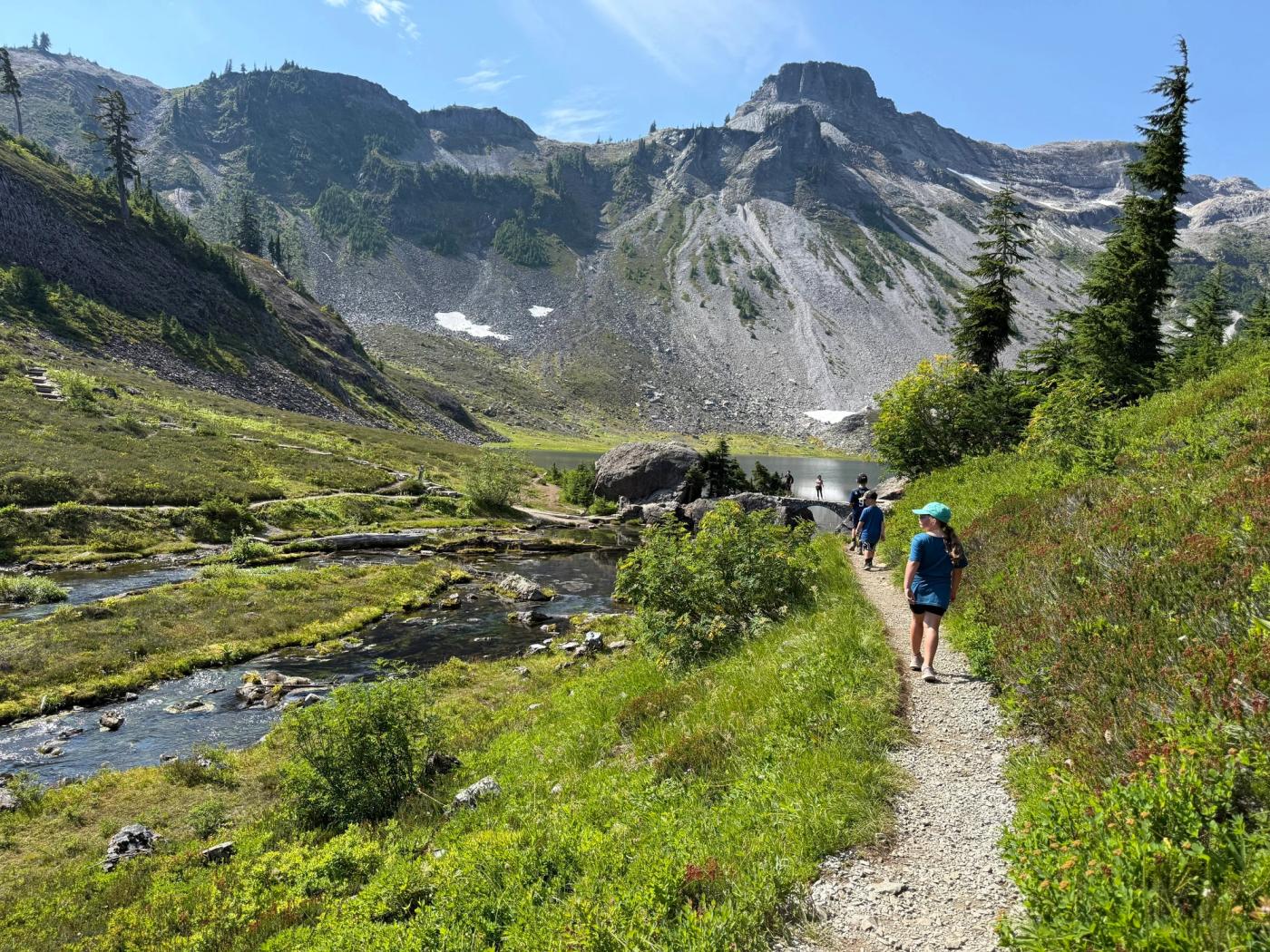
What we’ve learned hiking national parks with three young kids
“Can the kids actually hike that far?”
Jessie and I have asked ourselves some version of that question before almost every bigger family hike we’ve done.
How many miles is it?
How much elevation gain?
Is it too hot?
Is the trail exposed?
How long is this actually going to take us?
And, probably most importantly:
Are we going to end up carrying someone back to the car?
After months of traveling around the country and hiking national parks with our three kids, we’ve learned that the mileage listed on a trail map is probably one of the least useful numbers for answering that question.
Five relatively flat miles beside a lake can be easier than three miles straight up a mountain.
A six-mile hike on a cool morning can feel completely different from the same distance in 90-degree heat.
Elevation matters.
Terrain matters.
How much sleep everyone got matters.
And somehow a child who was “too tired to walk another step” can suddenly find enough energy to sprint toward the car when you mention ice cream.
We certainly don’t have this completely figured out.
But after hiking with our kids through deserts, mountains, canyons, and national parks across the country, we have a much better idea of what actually determines whether a family hike goes well.
And the biggest thing we’ve learned?
Our kids are usually capable of more than the mileage number makes us think.
There Isn’t a Magic Mileage for Kids
One of the most common questions parents ask when planning a hike is:
How many miles can my child hike?
I understand why.
It’s the easiest number to look at.
If the trail is two miles, that sounds manageable.
If it’s five miles, maybe we start questioning it.
If it’s eight miles, a lot of parents with young kids probably immediately cross it off the list.
But we’ve learned that mileage alone doesn’t tell us nearly enough.
I’d much rather know:
- How much elevation gain is there?
- What is the trail surface like?
- Is there shade?
- What’s the temperature going to be?
- Is the elevation significantly higher than we’re used to?
- Are there interesting things along the way?
- Can we stop beside a lake or river?
- Is the difficult section at the beginning or the end?
- How exposed is the trail?
- How easy would it be to turn around if someone isn’t doing well?
A four-mile hike can be miserable.
A six-mile hike can be fantastic.
Distance is only one piece of the puzzle.
Elevation Gain Changes Everything
If I had to choose between knowing the mileage or elevation gain before taking our kids on a trail, I’d probably want both—but elevation gain tells me a lot.
Walking four relatively flat miles around a lake is very different from climbing 2,000 feet in two miles.
That’s true for adults too.
With kids, it becomes even more noticeable.
Steep uphill sections slow everyone down. Steep descents can be surprisingly tiring too, especially after several hours on the trail.
And the elevation profile matters.
A trail that gradually climbs over several miles can be much easier for our kids than one that gains the same amount of elevation in a short, steep push.
We’ve learned not to see “4 miles” on a trail description and immediately decide whether it’s easy or hard.
We look at what happens during those four miles.
Heat Can Be Harder Than Distance
This became very obvious as we traveled through Arizona and Utah.
A trail that would be completely reasonable for our family at 60 degrees can become a very different adventure when temperatures start climbing.
Heat drains kids quickly.
It also means carrying more water, taking more breaks, finding shade, and being much more conservative with our plans.
That’s one of the reasons we’ve become big believers in starting early.
And sometimes early means really early.
At the Grand Canyon, Jessie and Hudson started down the South Kaibab Trail toward Skeleton Point at 4:45 a.m.
That sounds ridiculous until you understand why.
The goal was to be back on the rim before the heat of the day became a problem.
By 7:45 a.m., they were back at the trailhead.
Hudson was nine years old and handled the hike extremely well.
Could he have done the exact same hike later in the afternoon with the sun beating down?
Maybe.
But why find out?
Sometimes making a difficult hike work with kids isn’t about making the trail easier.
It’s about choosing the right conditions.
Don’t Underestimate How Much Kids Can Do
Before that Grand Canyon hike, Hudson looked down into the canyon and thought the South Kaibab Trail looked steep and scary.
Then he got onto the trail.
And it wasn’t nearly as intimidating as it had looked from above.
In most places, the trail was wide and easy to walk. He’s a fit kid who hikes with us regularly, and once he started moving, he realized he could handle it.
That experience has stuck with me.
Sometimes we look at a trail as adults and start deciding what our kids can’t do before they’ve even tried.
We’ve been guilty of it too.
But over and over on this trip, our kids have surprised us.
That doesn’t mean every child can hike the same distance.
It doesn’t mean age doesn’t matter.
It doesn’t mean we ignore their limits.
It simply means we’ve stopped automatically assuming young means incapable.
Give Them Something to Look Forward To
This might sound simple, but it makes a huge difference.
Kids don’t necessarily care that the trail has a spectacular geological formation three miles away.
They might care that there’s a waterfall.
Or a lake where they can throw rocks.
Or somewhere to fish.
Or a snack waiting at the top.
Or ice cream when we get back.
Grand Teton was a perfect example.
At Jenny Lake, our original plan was to take the boat shuttle across the lake and then hike to Hidden Falls and Inspiration Point.
The shuttle had more than a 90-minute wait.
So we changed plans.
We were walking.
The kids responded exactly how you’d expect when we announced that the new plan involved several additional miles.
Sighs.
Eye rolls.
Questions.
Then we mentioned ice cream.
Suddenly negotiations were possible.
We hiked around Jenny Lake, past Moose Ponds, to Hidden Falls and then climbed to Inspiration Point.
Instead of thinking about the entire distance, there was always another destination ahead.
Get to the falls.
Have a snack.
Climb to Inspiration Point.
Take in the view.
Start heading back.
Breaking a big hike into smaller adventures works much better for our kids than constantly talking about how many miles remain.
Snacks Are Basically Hiking Equipment
I don’t think I fully appreciated the importance of snacks until we started doing longer hikes with three kids.
Hungry kids and tired kids can look remarkably similar.
Sometimes a child who seems completely finished needs ten minutes, some water, and something to eat.
We carry more food than I think we’ll need.
Every time.
And somehow it disappears.
For longer hikes, we want things the kids actually want to eat—not just whatever looks ideal on a hiking checklist.
A snack can become motivation.
It can create a natural break.
And sometimes it completely resets everyone’s attitude.
We’ve learned that when morale suddenly falls apart on the trail, food is a pretty good first troubleshooting step.
Let Kids Set the Pace Sometimes
Adults naturally want to hike at an efficient pace.
Kids don’t care about efficiency.
They find a stick.
Then a rock.
Then a bug.
Then something in the water.
Then another stick that is apparently much better than the first stick.
This can be frustrating when we’re trying to reach a destination.
But we’ve learned that sometimes slowing down makes the entire hike better.
If the kids are enjoying themselves, we’re still accomplishing the goal.
We’re outside.
We’re moving.
They’re exploring.
Not every hike needs to become a race to the destination.
That said, there are also times when we need to keep moving—especially because of weather, heat, or daylight.
It’s a balance.
Complaining Doesn’t Always Mean They’re Done
This has probably been one of our biggest lessons.
Our kids complain on hikes.
All three of them.
Sometimes quite impressively.
We’ve heard:
“I’m tired.”
“How much farther?”
“My legs hurt.”
“I don’t want to hike anymore.”
And then fifteen minutes later, the same child is running down the trail.
We’ve learned that complaining and being physically unable to continue are not the same thing.
That doesn’t mean we ignore them.
We check in.
Do they need water?
Food?
A break?
Are they overheating?
Does something actually hurt?
Are they behaving differently than normal?
We know our kids, and over time we’ve gotten better at recognizing the difference between:
I don’t want to do this anymore
and
I really shouldn’t be doing this anymore.
Those are very different situations.
Know When to Turn Around
For all the talk about kids being capable of more than we think, this might be the most important part.
The goal isn’t finishing the hike.
We’re the parents.
Safety is our responsibility.
Weather changes.
Temperatures rise.
Kids get sick.
Someone can have an off day.
Sometimes the right answer is turning around.
Our Rocky Mountain National Park experience reinforced how quickly conditions can change in the mountains.
We had hiked from Bear Lake through Nymph and Dream Lakes to Emerald Lake. We spent time fishing and enjoying the sunshine.
Then a huge thunderstorm moved in.
The rain became incredibly heavy.
Water filled the trail.
Thunder and lightning were frighteningly close.
And we still had miles to get back.
The kids were not laughing then.
We kept everyone moving and eventually made it out safely.
Later?
Everyone thought the story was hilarious.
But the lesson for Jessie and me wasn’t that kids should simply push through anything.
It was the opposite.
Conditions matter.
Weather matters.
Our turnaround time matters.
And when we’re hiking with our kids, we need to leave ourselves a bigger safety margin than we might when hiking alone.
A Five-Year-Old Isn’t a Nine-Year-Old
This should probably be obvious, but it’s easy to fall into the trap of treating a family hike as though everyone has the same ability.
They don’t.
Our kids are different ages.
They have different personalities.
Different levels of fitness.
Different motivations.
And different reactions when they’re tired.
What Hudson can comfortably handle isn’t necessarily what Lincoln or Macie should be expected to do.
That affects which trails we choose and how we approach them.
Sometimes Jessie can take one of the kids on a harder adventure while the rest of us do something else.
The South Kaibab hike to Skeleton Point is a great example.
That was a Jessie and Hudson hike, not automatically a whole-family hike simply because Hudson could do it.
Giving one child a bigger challenge doesn’t mean everyone needs to participate.
So, How Far Can Kids Actually Hike?
Probably farther than you think.
But that’s not a mileage recommendation.
I don’t think there’s a chart that can tell you:
Age 5 = X miles.
Age 7 = X miles.
Age 9 = X miles.
Kids aren’t that simple.
A child who regularly hikes is different from a child doing their first trail.
A flat trail is different from a mountain climb.
Sixty degrees is different from ninety.
Sea level is different from 10,000 feet.
And an exciting trail with lakes, waterfalls, wildlife, and places to explore is very different from five monotonous miles.
Instead of asking only:
“How many miles is it?”
We’ve started asking:
“What will those miles actually require from our kids?”
That’s a much better question.
What We’ve Learned
After months of hiking with our kids, we haven’t discovered a perfect formula.
We’ve had great hiking days.
We’ve had complaining.
We’ve changed plans.
We’ve bribed children with ice cream.
We’ve gotten soaked.
We’ve underestimated trails.
And we’ve watched our kids accomplish things that initially looked too difficult.
The biggest lesson has been simple:
Don’t decide your kids can’t do something before giving them a reasonable opportunity to try.
Prepare for the trail.
Know your kids.
Check the weather.
Carry enough water.
Bring more snacks than seems necessary.
Start early when conditions demand it.
Be willing to slow down.
And be willing to turn around.
But don’t be afraid to challenge them.
Because eventually there will be a moment when they reach the waterfall, lake, overlook, or trailhead and realize:
I actually did that.
Those moments are one of the reasons we keep taking our kids outside.
We’re not trying to raise kids who can hike the most miles.
We’re trying to raise kids who aren’t afraid to look at something difficult and give it a try.
And sometimes the best place to learn that is on a trail.
-Kayla